Have you ever looked at a beautiful Filipino dessert and wondered if you could make it yourself?
That was me when I decided to bake Brazo de Mercedes for the first time. I love Filipino desserts, but this one always seemed like a challenge. It has a soft, fluffy meringue on the outside and a rich, sweet egg-yolk filling inside.
I finally gave it a try, and guess what? It was a success!
Making this dessert was a sticky undertaking, but it was also one of those kitchen experiences that made me proud. I followed a recipe inspired by Amy Besa and Romy Dorotan’s wonderful cookbook, Memories of Philippine Kitchens. The result was worth the effort, and I learned a lot along the way.

What Is Brazo de Mercedes?
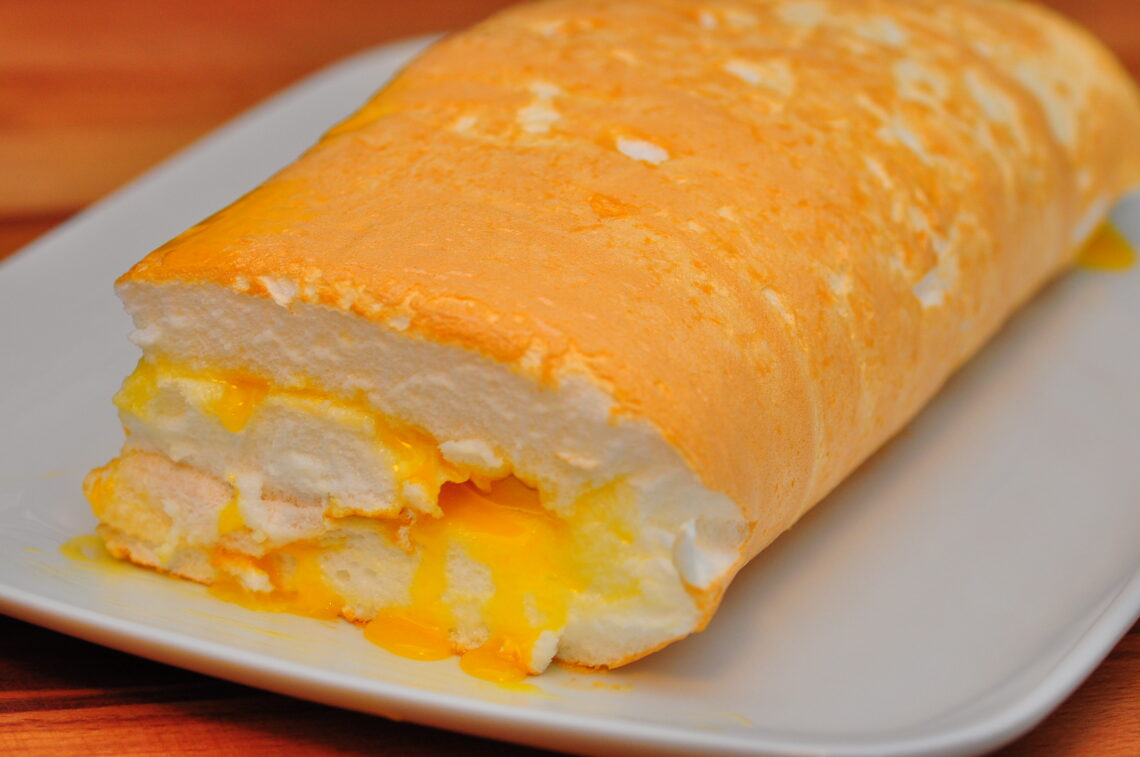
Brazo de Mercedes is a classic Filipino dessert made from baked meringue rolled around a sweet egg-yolk filling. Unlike a regular cake roll, it does not use flour in the meringue.
The outside is soft, light, and fluffy, while the filling is rich, smooth, and creamy. Each bite brings together two different textures and a sweet egg flavor that many Filipinos know and love.
It is often served during birthdays, family gatherings, holidays, and other special occasions. You can also find it in Filipino bakeries and cake shops.
For many of us, this dessert brings back memories of celebrations and sharing food with family. It looks fancy enough for a special event, yet it is also a comforting taste of home.
A Little History Behind This Filipino Favorite
Brazo de Mercedes has roots linked to the Spanish colonial period in the Philippines. Its name comes from Spanish and is often translated as “Arm of Mercedes,” with a connection to Nuestra Señora de las Mercedes, or Our Lady of Mercy.
The dessert is related to European rolled desserts, including the Spanish brazo de gitano. Over time, Filipino cooks made their own version using a light meringue and a sweet egg-yolk filling.
There is also a popular story about how Filipino desserts made use of leftover egg yolks. During the Spanish colonial period, egg whites were sometimes used in mortar and plaster for buildings. The extra yolks could then be used in cooking and sweets. This story is often shared as part of the history of Filipino egg-yolk desserts, though the exact origin of Brazo de Mercedes is not fully documented.
Whatever its exact beginnings, the dessert shows how Filipino cooking has taken outside influences and made them our own. It has become a familiar favorite that many families enjoy and pass down through generations.
My Inspiration: Memories of Philippine Kitchens
For my first attempt, I used a recipe from Memories of Philippine Kitchens by Amy Besa and Romy Dorotan as my inspiration.
I love this cookbook because it is more than a collection of recipes. It shares stories, food traditions, and the history behind Filipino dishes. Amy Besa and Romy Dorotan are known for their work introducing Filipino food to a wider audience through their New York restaurants, including Cendrillon and Purple Yam. Their cookbook helps readers understand how Filipino cuisine brings together local traditions and influences from other cultures.
I enjoy cookbooks that help me connect with Filipino food while teaching me something new. This recipe was a good chance to try a dessert I had admired for a long time.
My Brazo de Mercedes Recipe
This recipe uses two main parts: the meringue and the egg-yolk pastry filling.
Ingredients
Meringue:
- 12 large egg whites, at room temperature
- ½ teaspoon cream of tartar
- Pinch of salt
- 1 cup superfine sugar
Egg Yolk Pastry:
- 12 large egg yolks
- ½ cup sugar
- 8 tablespoons unsalted butter, cut into pieces
Step 1: Prepare the Eggs and Pan
Bring the eggs to room temperature. If they are cold, place them in lukewarm water for about 10 minutes.

Preheat the oven to 325°F. Line a 12-by-16-inch baking pan with parchment paper. Cut small slits at the corners so the paper fits snugly into the pan and up the sides.

Step 2: Make the Meringue
Place the egg whites and salt in the bowl of an electric mixer fitted with a whisk attachment. Beat at medium speed until foamy.
Add the cream of tartar and beat until the whites are just before soft peaks form. Slowly add the sugar, then beat on high speed until soft peaks form.

Spread the meringue evenly in the prepared pan. Smooth the top with an offset spatula.


Bake for about 30 minutes, until set and very lightly browned. Place the pan on a wire rack and let the meringue cool.

Step 3: Make the Egg-Yolk Filling
Set a fine-mesh strainer over a bowl and keep it near the stove.
Combine the egg yolks, sugar, and butter in the top of a double boiler. You can also use a metal bowl set over a pot of simmering water. Make sure the bowl does not touch the water.

Whisk constantly until the butter melts. Switch to a heatproof spatula and keep stirring, scraping the sides of the bowl, until the mixture thickens. This should take about 15 minutes.
Keep the heat gentle. If the water gets too hot, the egg mixture may curdle. Strain the filling right away to remove any lumps.

Step 4: Fill and Roll
Loosen the sides of the cooled meringue from the pan with a small knife.
Place a sheet of buttered parchment paper over the meringue. Carefully turn it over and remove the original parchment paper.
Spread the egg-yolk filling in a thin layer over the meringue, leaving about an inch clear around the edges.

With the short end facing you, gently lift the parchment and roll the meringue away from you, like a jelly roll.
Use a serrated knife to cut the roll into slices. Serve and enjoy!

Tips I Learned from My First Attempt
My first Brazo de Mercedes taught me that patience is just as important as the ingredients.
1. Make sure your eggs are at room temperature. This helps the egg whites whip well. If you forget to take them out early, the lukewarm water trick can help.
2. Keep the bowl and tools for the egg whites clean. Even a little grease or egg yolk can make it harder to whip the whites properly.
3. Watch the meringue closely. You want it set and lightly browned, not dry or overbaked. A meringue that is too dry may be harder to roll without cracking.
4. Keep stirring the filling. The egg-yolk mixture needs gentle, steady heat. Do not walk away from it. Straining it while warm also helps make it smooth.
5. Expect a little mess. This is a sticky undertaking! The meringue can cling to the parchment, and rolling it takes a gentle touch. Do not worry if it is not perfectly even. A homemade dessert can still look beautiful and taste wonderful.
Was It Worth the Effort?
Absolutely! My first Brazo de Mercedes was a success, and I was happy that I finally tried making it at home.
It takes time and care, but the ingredients are simple. The real challenge is handling the soft meringue and making a smooth filling. Once you understand the steps, the process feels less intimidating.
I also learned that making a Filipino dessert from scratch is a special kind of joy. It lets me enjoy a familiar flavor while learning a new skill in the kitchen.
I know this will not be my last Brazo de Mercedes. With more practice, I hope to make the roll neater and more even each time. For now, I am happy with my first try and proud that I made it myself.
Let’s Talk About Your Baking Adventures!
Have you ever made Brazo de Mercedes at home? Did your meringue crack, did your filling turn out too soft, or did you find a trick that made rolling easier?
I would love to hear about your experience! Share your baking stories, questions, and tips in the comments. If you have a family recipe or a special memory connected to this dessert, please share that, too.
Sometimes, the best part of cooking is learning from one another. My first Brazo de Mercedes was a success, and I hope it inspires you to try a Filipino favorite of your own.
One meal, one journey, one day at a time.